Case Study: Outside Lives Into the Woods 26
Authors(s), Creator(s) and Contributors: Anastacia Ackers, Evaluation Lead, Outside Lives
Publication Date: 18/09/2026
Categories: Case Studies
Partner(s): Outside Lives, Betsi Cadwaladr University Healthboard, The Little Learning Company, Flintshire County Council, North Wales Women’s Centre, ReSource Denbighshire, Polly Snape, Rachel Sumner, Sam Green, Voicebox/Natasha Borton, Nan Pickering
Funder(s): Arts Council Wales, Natural Resources Wales, Betsi Cadwalader University Health Board, The Little Learning Company, Flintshire County Council
Introduction
Into the Woods, a year-round arts, heritage and nature programme delivered by Outside Lives from its four-acre woodland site at Aberduna Hall, North Wales. Across four seasonal programmes, participants experiencing a range of challenges, including anxiety, poor mental health, social isolation and disengagement from education, were referred by partners including North Wales Women's Centre, Resource Denbighshire and Flintshire County Council. Guided by artists, storytellers and forest school practitioners, participants explored heritage crafts, woodland skills, creative writing, storytelling and nature connection. Through shared experiences in the woodland, the programme helps participants reconnect with themselves, others and the natural world.
The Challenge
Through our existing referral pathways, we recognised that many people were not yet ready to join larger groups or structured activities. Many were experiencing poor mental health, low confidence or other barriers that had left them disconnected from themselves, other people and the natural world. Before taking the next step, they needed a space where they could simply arrive, breathe, build trust and rediscover what brought them joy. We developed Into the Woods as that gentle first step, a welcoming introduction to Outside Lives and our woodland site. Through creative activities, participants were supported to reconnect with themselves, build confidence, form meaningful relationships and discover new opportunities for learning, volunteering and community participation.
The Approach
Into the Woods was delivered over twelve months through four seasonal programmes, each running for 10 weeks and tailored to the needs and interests of a different referral group. Across the year, 43 participants took part in 40 creative health workshops, alongside 12 co-production and evaluation sessions, supported by five artists, 3 cover artists and four volunteers. Sessions lasted three hours, either mornings or afternoons, with transport and a shared meal included to remove barriers to participation. Rather than delivering a fixed curriculum, each programme was co-produced with participants, allowing sessions to evolve in response to their interests and strengths. Led by practitioners with expertise in forest school, heritage crafts, storytelling, creative writing, poetry and community arts, activities included woodland skills, campfire cooking, seasonal crafts, storytelling and nature-based creativity. Every cohort developed its own identity, ensuring the programme reflected participants rather than asking them to fit a pre-designed model. Each lead artist was also provided with a dedicated wellbeing budget, recognising the emotional labour involved in building trust, holding space and supporting participants through creative health practice.
The Impact
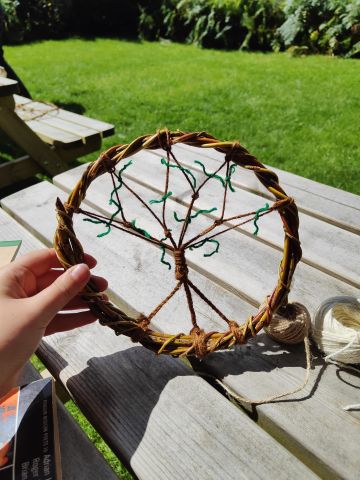
Into the Woods used attendance data, participant feedback, creative evaluation methods, facilitator reflections, case studies and co-production conversations throughout each seasonal programme. Participants consistently described reconnecting with themselves, other people, nature and future opportunities. Confidence grew through shared creative experiences, heritage skills and time spent outdoors, with many progressing into volunteering, further learning and community activities after the programme. Across the programmes, participants developed practical heritage skills including fire lighting, campfire cooking, willow weaving, storytelling and woodland crafts. One participant shared: "People talk about mindfulness... every week there was at least one activity like that. It's something I can take away." The evaluation highlighted that heritage became a creative health tool, enabling participants to build confidence, friendships and a lasting sense of belonging.
Lessons Learned
Co-production takes time. As relationships developed, participants increasingly shaped the programme, making flexibility more valuable than rigid session plans. We also underestimated the resources needed behind the scenes to deliver a year-long, high-quality creative health programme. Administration, number of artists on the project and practitioner wellbeing all required greater investment than anticipated. Future programmes will better resource these areas, protecting both participants' experience and the people delivering it.
The Legacy
Into the Woods is now embedded within Outside Lives' creative health programme, with participants progressing into volunteering, employment, further learning and other activities. The model continues through new partnerships and funding, adapting to different communities while keeping the same ethos. As one participant reflected: "I couldn't fit my treasure in the box because it's all here. (gesturing to the woodland)" That lasting connection to place is the legacy we hope to continue building.
Website and Social Media Links
www.outsidelives.org
Contact Details
Anastacia Ackers, discoveroutsidelives@gmail.com
Tags: Arts, nature, health, north east wales, denbighshire, storytelling, connection, wellbeing, resilience, mental health