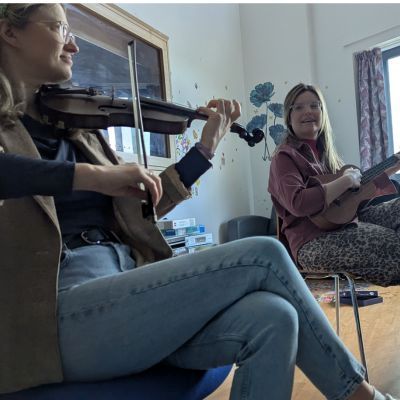
Case Study: Live music and visual arts for mental health development project
Authors(s), Creator(s) and Contributors: Vicky Daborn Tedder, Impact and Insight Manager, Music in Hospitals and Care
Publication Date: 18/06/2026
Categories: Case Studies
Partner(s): Cwm Taf Morgannwg University Health Board (CTMUHB)
Funder(s): Arts Council of Wales
Introduction
Since August 2025, Music in Hospitals & Care has delivered a person-centered live music project at Ty Llidiard, a CAMHS unit in South Wales. Led by a small team of three musicians the program offers young people (ages 13–17) a vital "escape" from the clinical ward environment through creativty. Through weekly interactive jamming and creative activities. Music in Hospitals & Care delivered a programme of weekly live music sessions alongside visual arts at Ty Llidiard, an in-patient CAHMS ward. The project aimed to reduce anxiety and build self-confidence. By co-producing sessions with hospital staff and the young people musicians transform the day into shared creative moments. Patients describe the experience as "superb," helping them to "take control again" during their recovery journey
The Challenge
Ty Llidiard is an in-patient CAMHS unit supporting young people aged 13-17 with acute mental health conditions including psychosis and eating disorders. Music in Hospitals & Care has delivered live music at the unit since 2021, and during a previous pilot of music and visual arts we found reported increased relaxation and positive interaction however this was felt to be too structured and with too much focus on the visual arts rather than the benefits of the music. This told us there was potential to explore the impact of changing the balance between these with a greater focus on the music but visual arts offered alongside this.
The Approach
We delivered 35 weekly live music and visual arts sessions at Ty Llidiard between September 2025 and May 2026, each lasting one hour. Three professional musicians on harp, violin and clarinet/ ukulele worked in rotating duos, ensuring continuity and relationship building while offering variety. Between 2 and 7 young people participated per session, with engagement shaped by the young people opting in to attending that day and exercising their agency. The programme was co-designed with the unit's Music Therapist and Art Therapist who briefed musicians before each session and provided debrief support afterwards. Sessions took place primarily in space chosen as neutral, non-clinical territory and were flexible by design, responding to patient mood and preference. Young people chose how and whether to engage, selecting music from Bach to Taylor Swift, playing instruments alongside musicians, drawing and creating nature-based collages and drawings when possible. Musicians completed reflective feedback forms after every session and participated in regular wellbeing check-ins with Music in Hospitals and Care which are essential in an environment one musician described as one that "really pushes you in ways that lots of others don't'
The Impact
The project transformed the clinical ward into a "creative hub" for connection. Evaluation involved qualitative analysis of weekly musician reflective feedback, participant and musician interviews, a musician and staff focus group and creative feedback such as post-it notes stuck to a baby harp. This data revealed that music facilitated emotional regulation and social bonding. For instance, soft music helped steady a hyperventilating patient for medical readings, and a reserved participant gained the confidence to lead a "band," noting: "it helped my confidence". Intended outcomes of joy and escape were achieved, while unintended successes included music's ability as a "chief distractor" during medical observations. Staff observed that "incidents" rarely occurred during sessions, providing a calm contrast to ward life. Musicians also experienced professional growth, abandoning technical perfection for person-centered connection. The project "leveled the playing field," humanising staff-patient relationships. However, the inconsistent integration of visual arts was identified as a "lost opportunity" to engage shy participants. Finally music reached hidden audiences, with staff in meetings listening from open windows
Lessons Learned
Reflecting on our work we saw person-centered jams successfully built patient agency. Challenges included inconsistent art integration highlighting the need of clearer communication about roles and when the visual arts are appropoate. Learning from this we'll explore using a WhatsApp group for planning and schedule well-being check-ins in advance. We’ll also explore creating "goodbye videos" for closure. We also reinforced the importance of regular wellbeing calls with the musicians and the support they need in working in such a complex environment
The Legacy
The project's legacy is a shift for young people, musicians, and the ward itself. Patients moved from passive observers to being creators, gaining tools for self-expression that travel with them beyond the unit. Musicians shed the "college head" mindset, reinfrcing that connection matters more than technical precision. We have also created a guide to evaluation in CAHMS settings exploring what we have learnt from taking a codesign approach. We have also created guides on working in CAHMS settings for musicians and evaluation.
Contact Details
Vicky Daborn Tedder, Impact and Insight Manager Vicky@MIHC.org.uk
Tags: Mental Health Children and Young People, Music, CAHMS, Hospital, South Wales, Cwm Taf Morgannwg