Enhancing Wellbeing
Authors(s), Creator(s) and Contributors: Sophie Pritchard & Dawn Wimpory (BCUHB), Marie-Claire Howorth, Lead Artist.
Publication Date: 31/03/2026
Categories: Case Studies, English
Supporter(s)/Funder(s): BCUHB
Partner(s): Bangor University, Canolfan Gerdd William Mathias
Funder(s): Arts Council Wales, Dawns i Bawb (in kind support), CGWM (in kind support) Betsi Cadwaladr University Health Board (BCUHB) (staffing, in kind), Bangor University (resources, in kind).
Through Community Based Spontaneous Live Music Tailored to Enable Communication Between Parents and Neurodiverse Children
Introduction
From December 2023, our 2-year project encompassed training sessions and workshops to support social communication and emotional wellbeing in families of neurodiverse children. Live music was individually tailored in Music Interaction sessions to enable interaction within child-adult dyads. They were delivered with BCUHB, whilst group sessions ran in partnership with CGWM and Dawns i Bawb. Training sessions for Artists and professionals focused on the benefits of music and dance/movement for Neurodiverse children. Bangor University-based evaluation considered questionnaire responses and video-recorded interaction. Clinical observations, qualitative, and some quantitative, analyses indicated benefits in family empowerment, professional knowledge, and dyadic social communication.
The Challenge
Autism Spectrum Condition (ASD) is characterised by persistent social reciprocity difficulties in those with greatest ASD needs. Some researchers recognise this as due to differences in social timing: the process that guides back-and-forth interactions with others (Delaherche et al., 2012). Evidence suggests that supporting social timing may help development in sociability, communication and pretence (Wimpory, 2015). In contrast to social timing, musical processing is unaffected in ASD individuals (Jamey et al., 2019), therefore music can be used to create a rhythmic framework to enhance social timing in autistic children. Music Interaction sessions have shown promise in empowering parents to communicate with their autistic child, thereby enhancing their child’s communication.
The Approach
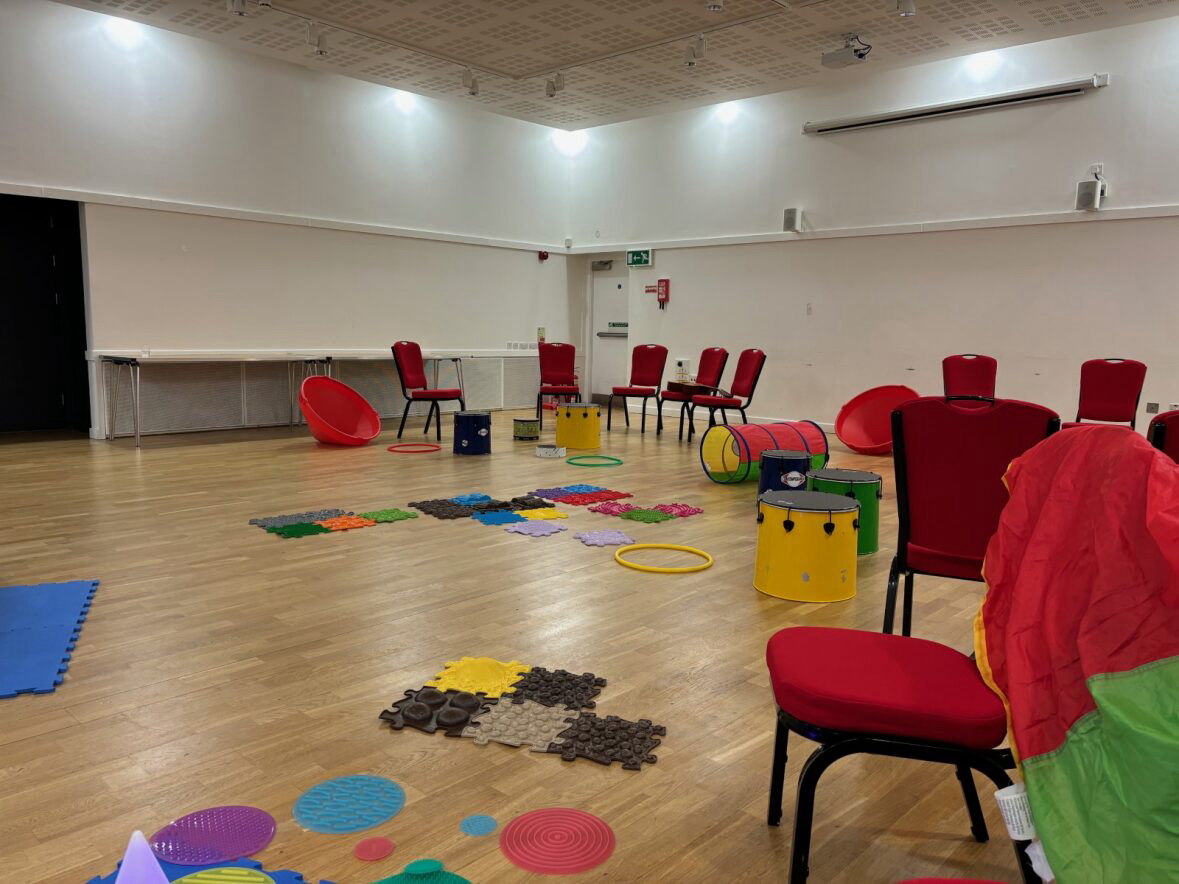
The project Lead Artist delivered 247 1-hour Music Interaction (MI) workshop sessions to 494 participants in the community between December 2023- December 2025 across Gwynedd and Anglesey. All sessions were co-produced using the BCUHB session framework. 37 further 1-hour MI sessions were facilitated by a Dance Artist and the Lead Musician weekly in schools. Specialist mentoring was provided to the Dance Artist by the lead musician to ensure sustainability and session quality. MI took place on a 2:1 basis with the child, a familiar adult play partner/facilitator (parents/school staff) and a musician. In addition, 10 monthly 2-hour family sessions were attended by 103 participants from neurodiverse families, offering the opportunity for connection and empowerment. Family sessions were attended by the Lead Artist and a further “Trainee Artist”. Trainee Artists each attended 4 3-hour specialist training sessions regarding the importance of art for supporting neurodivergence, before assisting with family groups. Further training was provided to members of the community who work with autistic children (Teachers; TAs; Early Start Workers). 2x 1 hour and 1 x 2-hour training sessions were attended by 68 community professionals. The total budget for this project was £38,074.
The Impact
Questionnaires assessed family experiences of MI (both 2:1 and group sessions), and artist and professional experiences of training sessions. Preliminary quantitative analysis has outlined findings which highlight possible positive impacts of MI on communication. Quantitative analyses are ongoing and planned for inclusion in peer-reviewed academic publication(s). Questionnaire Findings: 100% of professionals definitely agreed/ agreed that the sessions were useful and developed their understanding of MI and Autism. 100% of families enjoyed their sessions and felt that their tutor was suitable, suggesting that artist training had been effective. Families stated that they felt empowered and confident following sessions, and that they felt secure in the knowledge that they were positively supporting their children. Artists reported that initially they found it “tiring” to allow the “freedom” of spontaneous music to guide them through sessions, but once they “submitted” to this freedom, they reported that the sessions were “rewarding” and that they felt “humbled” by the parents they met. In regards to their learning and key takeaways, artists most commonly reported that they learnt how to communicate with autistic children, to be slow and gentle, and to personalise their practice to each child’s needs to ensure barriers to accessing art are removed. At the end of training, our artists collaborated to develop a “toolbox” to use alongside their art, which they will utilise to continue to support autistic children to access art in the future.
Lessons Learned
Sessions planned months ahead supported as many families as possible, but some found this tricky, due to neurodiversity’s challenging nature; leading to cancellations. Families cited healthcare appointments, child wellbeing, and lack of sibling childcare preventing attendance last minute. We used cancellations as a chance to reassure families and develop better relationships. Our initial quantitative analysis was too ambitious in focusing on progress outside of MI sessions. These experiences will guide our future practice and analyses.
The Legacy
BCUHB staff will explore future funding to enable 2:1 MI sessions to continue. We encourage the participant artists to utilise their training and acquired “toolbox” in their future practice, ensuring that neurodivergent children are supported in accessing the Arts. Artists are recommended to share their acquired knowledge and skills with other Artists in Gwynedd and Anglesey as this will benefit to arts & wellbeing ventures going forward. We value our experience of, and seek to continue working with, Artists of different modalities.
Website and Social Media Links
https://cgwm.org.uk/en/ https://facebook.com/cgwmathias http://dawnsibawb.org https://facebook.com/dawnsibawb https://pmc.ncbi.nlm.nih.gov/articles/PMC9186469/
Contact Details
Sophie Pritchard; sophie.pritchard2@wales.nhs.uk
Tags: Neurodiversity, Autism Spectrum Disorders, communication support, family wellbeing, NHS, dance, music, movement