Case Study: Art for Lifes Sake Creativity Connection and Wellbeing in Community Hospitals
Authors(s), Creator(s) and Contributors: Denise Lord, Development Co-ordinator, More Than Music Cymru
Publication Date: 12/10/2026
Categories: Case Studies
Partner(s): More Than Music Cymru (delivery organisation); Cwm Taf Morgannwg University Health Board (health partner); Anne Culverhouse Evans (lead artist); Mab Jones (independent evaluator).
Funder(s): rts Council of Wales (Groundwork & Test), Cwm Taf Morgannwg University Health Board, Moondance Foundation
Introduction
Art for Life’s Sake was a five-month creative health pilot (May–September 2026), delivered by More Than Music Cymru in partnership with Cwm Taf Morgannwg University Health Board, with funding from Arts Council of Wales. Led by visual artist Anne Culverhouse Evans, the project delivered 60 participatory arts sessions across three Rhondda Cynon Taf community hospitals: Ysbyty George Thomas, Treorchy; Ysbyty Cwm Rhondda, Llwynypia; and Ysbyty Cwm Cynon, Mountain Ash. Working primarily with patients awaiting discharge, transfer or onward care, the project explored how meaningful creative activity could improve emotional wellbeing, reduce isolation and offer opportunities for self-expression, companionship and achievement. Through accessible, person-centred art sessions, it sought to bring creativity, connection and a renewed sense of purpose into the hospital experience.
The Challenge
For patients awaiting discharge, transfer or onward care, prolonged hospital stays can bring uncertainty, frustration, boredom and isolation. Although medically optimised, many remain in hospital for extended periods, with limited opportunities for meaningful activity, social interaction or personal choice. Hospital care understandably prioritises physical and clinical needs, but emotional wellbeing, confidence and a sense of identity are equally important. Patients can become defined by their condition or circumstances, losing touch with the interests, abilities and relationships that make them who they are. Art for Life’s Sake was developed to address this gap, exploring whether regular, accessible creative activity could offer more than diversion: opportunities for self-expression, achievement, companionship and renewed purpose, helping patients reconnect with themselves and others during a challenging period of their lives.
The Approach
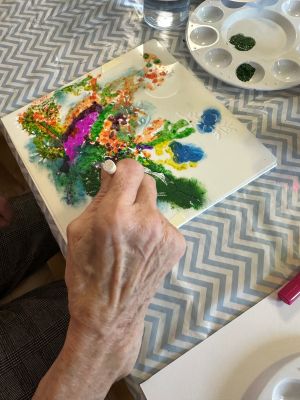
Between May and September 2026, visual artist Anne Culverhouse delivered 60 participatory arts sessions across three Cwm Taf Morgannwg University Health Board community hospitals: Ysbyty George Thomas, Treorchy; Ysbyty Cwm Rhondda, Llwynypia; and Ysbyty Cwm Cynon, Mountain Ash. Working primarily with patients awaiting discharge, transfer or onward care, the project offered regular opportunities to explore visual art in a welcoming, supportive environment. Sessions were designed to be accessible, flexible and responsive to individual interests, abilities and circumstances, including those experiencing reduced mobility, fatigue, sensory impairments or difficulties with dexterity. Rather than following a rigid programme, Anne encouraged patients to experiment with materials, develop their own ideas and participate at their own pace. Some discovered unexpected abilities or renewed an interest in art, while others found pleasure in simply making something, sharing memories or enjoying conversation. There was no expectation of artistic experience or achievement; the emphasis was on the creative process, personal choice and enjoyment. Group sessions encouraged interaction between patients who might otherwise have limited opportunities to socialise. The creative activity also drew in staff, relatives and visitors, creating moments of shared experience beyond the usual routines of hospital life. The pilot recorded 261 attendances and an estimated 101 individual participants, including patients, staff, students and family members. Throughout delivery, the artist worked within the practical realities of busy hospital wards, adapting activities and support to participants' changing needs. This flexibility was central to exploring how participatory arts could become a meaningful and accessible part of the hospital experience.
The Impact
Independent evaluator Mab Jones used a mixed-methods approach, combining attendance records, 53 paired wellbeing Check-In/Check-Out responses, patient and staff interviews, observation and artist reflections. This captured both measurable changes in immediate wellbeing and participants' personal experiences. The findings were encouraging. Among paired responses, the proportion reporting feeling calm increased from 36% to 85%, connected from 40% to 85%, and interested from 66% to 91%. Those reporting anxiety fell from 38% to 9%. These results reflect immediate, self-reported changes rather than clinical or longer-term outcomes. Qualitative evidence reinforced the findings. Patients described enjoyment, companionship, achievement and renewed confidence. Some discovered creative abilities they had not recognised, while others continued making art independently between sessions. One participant remarked, “I really like Fridays coming around,” illustrating the value of regular activity and something to anticipate. An important additional benefit was the wider social atmosphere created by the sessions. Staff observed improvements in mood and interaction, while artwork and conversation encouraged connections between patients, relatives and staff. As one charge nurse observed, the activity helped bring people away from their patient role and back towards themselves. The evaluation also identified practical barriers involving mobility, staffing and access to sessions, providing valuable learning for future delivery. Overall, the pilot demonstrated that meaningful creative engagement can offer moments of calm, connection, confidence and personal achievement within the challenges of hospital life.
Lessons Learned
Regular sessions fostered familiarity, anticipation and confidence, while flexible, person-centred facilitation enabled patients with diverse needs to participate meaningfully. However, mobility, fatigue, staffing pressures and ward routines sometimes restricted access. Future delivery will strengthen communication with ward teams, introduce more bedside and small-group opportunities, and provide greater continuity. Evaluation methods will also be simplified, with dedicated support where needed. Importantly, the pilot highlighted the potential value of creative activity for stroke patients, opening opportunities to explore its contribution alongside rehabilitation in the next phase.
The Legacy
Art for Life’s Sake has provided compelling evidence of the value of creative engagement within community hospitals, alongside practical learning about accessibility, continuity and partnership working. Building on this foundation, More Than Music and Cwm Taf Morgannwg University Health Board hope to develop a sustained programme, with a stronger focus on stroke recovery and exploring creative opportunities beyond discharge. The next phase will investigate how arts activity can complement rehabilitation, strengthen connections between hospital and community, and generate evidence to inform future NHS investment and commissioning. The ambition is to move from a successful pilot towards an embedded, sustainable creative health pathway.
Website and Social Media Links
More Than Music Cymru – Project delivery organisation https://www.morethanmusic.org.uk Cwm Taf Morgannwg University Health Board – Health partner https://ctmuhb.nhs.wales Arts Council of Wales – Project funder https://arts.wales Art for Life’s Sake – Independent Evaluation Report Mab Jones, Creative Evaluator (October 2026).
Contact Details
Denise Lord - Development Co-ordinator, More Than Music Cymru
Tags: Arts and health, creative health; participatory visual arts; community hospitals; older adults; patient wellbeing; social connection; Rhondda Cynon Taf; Wales.