Why Creative Activities Matter for Older Men Living with Parkinson’s
01/07/2026 | Author: Neil O'Toole
Neil O’Toole, Chair of Parkinson’s UK Cardiff, explores why older men living with Parkinson’s are often less likely to engage in creative activities, drawing on research and the Cardiff branch’s own experiences.
Good Morning everyone.
My name is Neil O’Toole and I am the Chair of Parkinson’s UK, Cardiff. As the Cardiff branch of the charity we offer friendship and support, as well as operating a range of activities across the city, for people living with Parkinson’s, their families and carers.
A recent report from The Baring Foundation highlighted that older men were much less likely to take part in creative ageing activities than older women. I will discuss the difficulty of attracting older men living with Parkinson’s to creative activities, as well as highlighting an example of what we’re doing to overcome these challenges.
Parkinson’s disease is a progressive neurological disorder. It is the fastest growing neurological disorder in the world and the number of people with the condition has more than doubled since 1990. Parkinson’s causes involuntary shaking and tremor; stiff and inflexible muscles and impacts vocal strength including volume and clarity. It can also be linked to anxiety, depression and loss of memory. Given that at diagnosis, the vast majority of men are aged over 60, they qualify as ‘older men’.
When we think about Parkinson’s disease, our minds often jump straight to the physical toll - the tremors; the rigidity and the loss of motor controls. We tend to focus on clinical management of the condition. But today I want to talk about a different kind of intervention - one that doesn’t come in a pill but instead arrives on a dance floor, through using the voice to sing or the beating of a drum. I am talking about the engagement of older men with Parkinson’s in creative activities.
Ageing in itself can be an isolating journey, particularly for men. Retirement can often strip away a man’s primary social network or sense of purpose. Traditional community spaces can feel alienating. Many men view creative activities as exclusionary, overly academic or simply ‘not for them’. When combined with a diagnosis of Parkinson’s, the challenges for older men are even more profound. Society often conditions men of this generation to value independence, physical strength and emotional stoicism, Parkinson’s directly attacks these traits, which can lead to social withdrawal, depression and a loss of identity. This is where the arts step in, serving not as a distraction but as a profound therapeutic bridge.
The neurological and physical benefits of engagement in creative activities for older men with Parkinson’s are compelling. For example, the impact of neuroplasticity, where involvement can lead to bypassing damaged speech and motor pathways in the brain which then rewires itself, finding new neural pathways to express movement or thought. Parkinson’s can often weaken the voice and singing in a choir acts as a form of speech therapy. Dancing directly targets gait freezing, improves balance and reduces the risk of falls.
Participation in creative activities can also help the individual to reclaim their Identity. Many individuals with Parkinson’s feel their identity is eclipsed by their medical diagnosis. Participating in creative activities - whether through a dance programme, choir, or playing in a band helps men shift their focus from being ‘patients’ to being ‘creators’ and ‘dancers’. Further, it helps to combat social isolation. Older men with Parkinson’s are often at higher risk of social isolation due to physical limitations or the perceived stigma of a neurological diagnosis. Participating in group creative environments unites them with peers who understand their lived experience, building lasting friendships and a strong community.
As Parkinson’s UK Cardiff we recognise these benefits and have incorporated a number of creative based activities within the broader portfolio of support that we provide. We have engaged a professional band leader to lead a samba band, that meets weekly, and involves participants drumming and playing a variety of percussion instruments. The National Dance Company Wales provides a weekly Dance For Parkinson’s class in Cardiff. We have also partnered with a dance studio to provide a weekly ‘Active Dancing’ session for people who want a more intense and challenging workout than a standard Dance for Parkinson's class, Finally we have a choir, Good Vibrations Chorus, run in conjunction with the Royal Welsh College of Music and Drama.
All of our activities welcome men and women participants. Currently both of the dance classes are dominated by women attendees and we have further work to do to encourage more males to participate. We do however see broadly equal attendance by men and women of the Samba Band and the Good Vibrations Chorus choir.
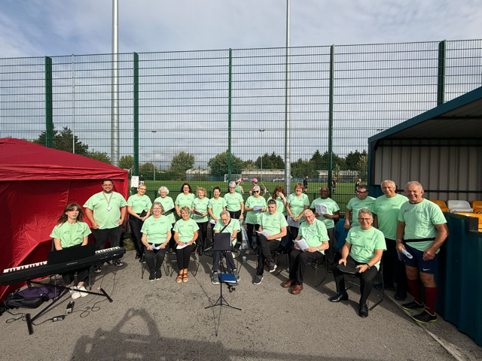
Looking at the latter in particular, the choir was developed by the College in collaboration with Parkinson’s UK Cardiff. It delivers weekly, term-time sessions of 90 minutes to an average attendance of around 25 - 30. This year the Chorus has been funded by the Arts Council of Wales. Vocal exercises, developed with health professionals, are a key component and are welcomed particularly by male participants. Singing is led by a professional choir master, pianist who are Graduates of the College, as well as 5-6 supporting college music student volunteers. The songs performed have included a variety of popular music, traditional Welsh songs and classical works. The group have performed publicly at locations such as The Senedd and the Parkinson’s Football World Cup.
Crucially, the Chorus delivers physical and neurological interventions disguised as creative expression. The targeted vocal exercises and group warm-ups function as a rigorous workout for the speech muscles. By singing both familiar and new songs, attendees actively counteract the voice loss and muscle tone depletion common to the condition. Group singing strengthens vocal cords, expands lung capacity, and restores vocal loudness. Furthermore, connecting to the rhythm and moving together helps relax stiff muscles, reduce tremors, and improve overall posture. For those men attending, singing is not a passive hobby; it is a physical reclamation of control over their own bodies.
Beyond the physical rehabilitation, the psychological impact of the Chorus is life-changing. Group singing lowers stress hormones, releases endorphins, and directly combats anxiety and low mood. For the older male participants, the weekly rehearsals forge a unique, supportive brotherhood. In this space, they are not defined by a degenerative medical label, nor do they need to pretend everything is fine. Instead, they share a collective vulnerability and a deep, authentic sense of "shared joy".
We have found that the single most effective lever to increase male attendance is to position the choir as an activity for both the person with Parkinson’s and their partner or carer. Older men are far more likely to attend a new group if their partner accompanies them. It removes the friction of trying something new alone. For women, it transforms the choir into a shared, positive memory outside the standard caregiving routine.
Rehearsing both familiar and new songs forces the brain to build cognitive reserve, giving older men a sense of mental clarity. We seek to cultivate a non-judgmental shared identity. For many men, finding a space where they do not feel defined by an illness or ageing can be difficult. The choir brings together individuals with similar health struggles, their families, and carers, it strips away the stigma of symptoms. Men can sing, stumble, or experience tremors without judgment. There are no intense performance pressures or strict auditions. The environment emphasises having a laugh and enjoying a shared purpose.
By gathering regularly, these men confidently step out of their shells and back into community life. They connect with peers who truly understand their daily hurdles and celebrate what they can achieve together rather than mourning what has been lost. The Good Vibrations Chorus proves that while Parkinson’s may attempt to quiet a person's voice and restrict their movement, the power of collective harmony can help these men fight back - finding renewed strength, laughter, and a profound sense of belonging.
The end.
Neil O'Toole