Jessica Ostrowicz at Discover Bucks Museum - Marion Cheung, Go & See Microbursary 2025-26
03/04/2026 | Author: Marion Cheung
Reflections on artist Jessica Ostrowicz’s 12 – month residence, in partnership with Ikon Gallery's Art in Prison programme. We explore how engaging as an artist - not a teacher - creates a collaborative space for residents of HMP Spring Hill (A Category D – open prison) to support mental health, allowing the men to navigate the 'difficult terrain' of incarceration through shared practice and authentic creative voice.
As an artist in the Das Clarks collective, this visit was vital to understanding meaningful co-production in a prison setting with fewer restrictions than our own. I wanted to learn if there were co-creative techniques that could be adapted for our future work. By focusing on the theme of ‘Home,’ the artist moved beyond institutional frameworks to facilitate artefacts that felt deeply personal rather than purely educational.
Seeing how conversations were woven into the art was inspiring; the artist’s presence was subtle, ensuring the inmates’ voices took precedence. Observing the work’s evolution from the studio to the gallery demonstrated how authentic dialogue can shape a professional exhibition, offering a powerful model for my own future practice.
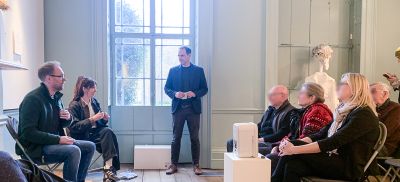
We visited Discover Bucks Museum (Aylesbury) to see Jessica Ostrowicz' exhibition 'Time and Time Again' for an artist talk hosted by Ikon gallery's Art in Prisons programme producer James Latunji-Cockbill. The talk gave us the opportunity to experience the body of work co-created during her residency at HMP Spring Hill (Category D open prison) with inmates over a period of 12 months. The work contained sculpture, sound installation, photography, drawing and creative writing.
The Ikon Gallery Prison Arts Programme selected artist Jessica Ostrowicz for her art practice of "beautiful materiality," that explores fragility, transience, and the theme of "Home" and was curious to see how this would translate within a prison residency. Ostrowicz transformed the harsh environment into "sweet gestures that were human," utilising, for example, small stones as "placeholders" to honour inmate voices whilst signifiying her presence within the work. Having previously found structured teaching restrictive, Ostrowicz utilised processes designed to "break down the entry points of fear" with simple, found materials. This involved encouraging participants to create the "worst art" possible, emphasising the importance of "embracing failure and things that aren't quite right." Her approach focused on deep listening and creating meaningful, personal connections with participants rather than working toward rigid, visible outcomes.


In partnership with HMP Parc, we are planning a new programme to include sensory processes, creative writing and found materials. Despite the stricter Category B constraints - limiting tools like cameras or audio - we are inspired by Ostrowicz’s approach to artistic presence.
Moving forward, we will explore how to remain visible within the work while "honouring the participants' voices" with additional depth. We aim to balance skill-sharing with co-creation, adopting Ostrowicz’s ethos: “I’m making what I’m making because of them.”